



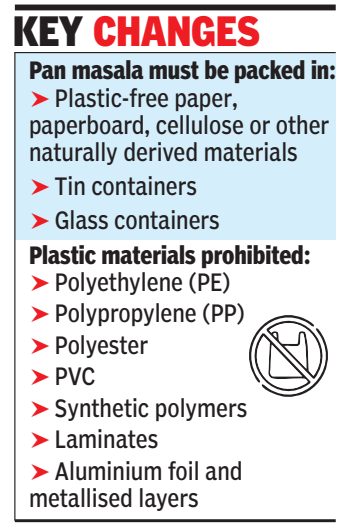
NEW DELHI: The tiny plastic sachet that has become synonymous with pan masala may finally be on its way out. The Food Safety and Standards Authority of India (FSSAI) has notified plastic-free packaging norms for the product, a move experts say could further enforcement of an existing ban by allowing the food regulator to act directly against violators.The amended Food Safety and Standards (Packaging) Regulations, 2026, require pan masala to be packed only in paper, paperboard, cellulose or other naturally derived materials free from plastic, or in tin or glass containers. The notification prohibits use of materials containing polyethylene, polypropylene, polyester, PVC, synthetic polymers, laminates, aluminium foil and metallised layers, and also makes the packaging subject to Plastic Waste Management Rules, 2016.
The rules came into force upon their publication in the gazette
A senior FSSAI official told TOI that pan masala has been specifically included under Schedule IV of packaging regulations to provide Food Business Operators with clear guidance on suitable packaging materials, given the widespread use of small single-use packs and the environmental concerns arising from their disposal. However, environmental experts said the notification primarily furthers enforcement rather than imposing fresh prohibition.“The Plastic Waste Management Rules, 2016, had already placed an explicit legal ban on plastic sachets for gutka, tobacco and pan masala. The FSSAI notification reinforces that mandate through food safety regulations,” said Siddharth G. Singh, programme manager, solid waste management and circular economy, Centre for Science and Environment.He said enforcement of Plastic Waste Management Rules has remained patchy because it largely depends on state pollution control boards and local bodies. Bringing the requirement under the ambit of food safety regulations will allow FSSAI to act directly against Food Business Operators, plugging an enforcement gap that environmental laws alone struggled to address, he said.Singh said pan masala was specifically targeted because the sector relies heavily on use of small single-use sachets, which have a high littering potential and among the lowest collection rates.India’s pan masala industry, pegged at anywhere between Rs 45,000-60,000 crore is bracing for a slowdown in revenues for at least a quarter following the FSSAI’s directive. Much of the industry sales comes from small plastic sachets and packs, said executives. Also, plastic is also used in most packs in some form or the other, they said. While there is bound to be inventory losses for firms, players who get most of their sales from plastic packs may be staring at business shutdowns, said an executive with a large brand who did not wish to be identified. “The industry had sought more time from the govt. The impact will be huge. The market will consolidate and smaller brands will perish,” the executive said.DS Group which owns the Rajnigandha brand declined to comment while Vimal Pan Masala and Pan Bahar could not be immediately reached for comments. Bigger players have already started moving to non-plastic packaging anticipating such a directive and can afford to take a short-term sales hit.
Share your thoughts in the comments
Be respectful · TOI community guidelines
“Biodegradable materials can deliver the required barrier protection, strength, machinability and shelf life for pan masala packaging, and biodegrade naturally under ambient tropical conditions,” said Jeevaraj Pillai, President – Flexible Packaging and New Product Development, UFlex which works with pan masala brands.

